
Private Office or Traditional Lease? A Practical Guide for Growing Dublin Teams
A decision framework for comparing flexibility, setup costs, services, privacy and expansion risk.
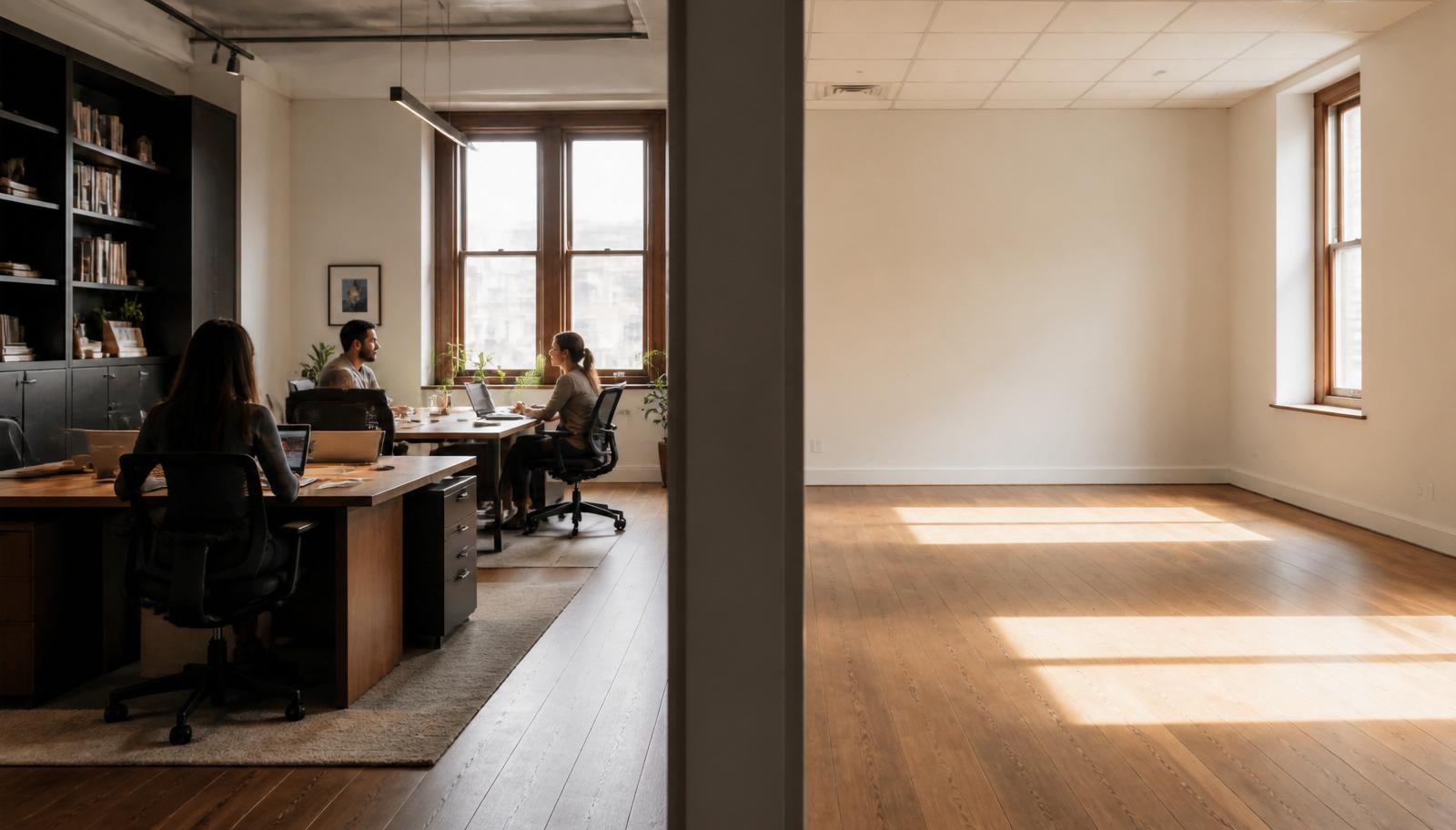
As a company moves beyond its first stage of Irish market entry, a recurring question emerges: is it time to move from a flexible private office into a traditional commercial lease? There is no universally correct answer — the right choice depends on headcount certainty, growth trajectory and how much operational responsibility the business wants to carry directly.
Setup cost and time
A private office is typically ready for immediate occupation — furnished, connected and staffed. A traditional lease usually requires a fit-out period, furniture procurement, IT installation and a longer runway before the space is usable, along with significant upfront capital.
Contract flexibility and term length
Private office agreements are generally structured in months rather than years, allowing a business to scale up, scale down or relocate with limited notice. Traditional commercial leases in Dublin typically run for several years and can include obligations that are difficult to exit early.
Services included
Private offices typically include reception, cleaning, utilities, internet and meeting-room access within a single agreement. A traditional lease usually requires the tenant to arrange and manage each of these separately, which adds administrative overhead, particularly for a lean or newly established team.
Privacy and control
Traditional leases generally offer greater control over layout, branding and long-term customisation. A well-designed private office can still offer strong privacy and a dedicated identity, but with less scope for permanent structural changes.
Scalability and expansion risk
A private office allows a business to add or reduce space in response to real headcount changes, reducing the risk of paying for unused capacity. A traditional lease requires the business to estimate future headcount in advance — underestimating leads to disruptive early relocation, while overestimating means paying for space that sits empty.
Hidden costs to consider
Traditional leases can carry costs beyond the headline rent, including service charges, dilapidations obligations at lease end, insurance, and the ongoing cost of managing facilities, IT and reception independently. These should be factored into any direct cost comparison.
Questions to ask before deciding
- How confident is the leadership team in headcount projections for the next 12 to 24 months?
- Does the business need significant customisation or branding within its space?
- How important is minimising upfront capital commitment at this stage?
- Would the business rather manage facilities directly or have them included as a service?
- Is the current growth stage stable enough to justify a multi-year commitment?
A staged approach
Many growing companies use a private office as the operating model through their first phase of Irish growth, then reassess once headcount, budget and long-term plans are clearer — sometimes moving to a larger private suite, sometimes to a traditional lease.
FAQ
Is a private office more expensive than a traditional lease long-term? It depends on team size and stability — private offices typically cost more per desk at scale but remove many indirect costs and risks associated with leases.
Can a private office scale to a larger team? Yes, many providers offer larger private suites and multiple offices to accommodate growth without changing provider.
Frequently asked questions
How quickly can we move into a private office in Dublin?
Our offices are fully serviced and furnished, so most teams are operational within days of signing — desks, fibre connectivity, meeting rooms and reception are already in place.
Where are Prosperity Chambers locations?
We operate four A-grade buildings in central Dublin, all within walking distance of Luas, DART and main bus corridors.
Can we scale the office up or down as the team changes?
Yes. Agreements are flexible and we can move you between suites or locations as headcount changes, without renegotiating a long commercial lease.
Can I book a meeting room without being a member?
Yes — meeting rooms and boardrooms can be booked on demand, with AV, refreshments and front-of-house support included.